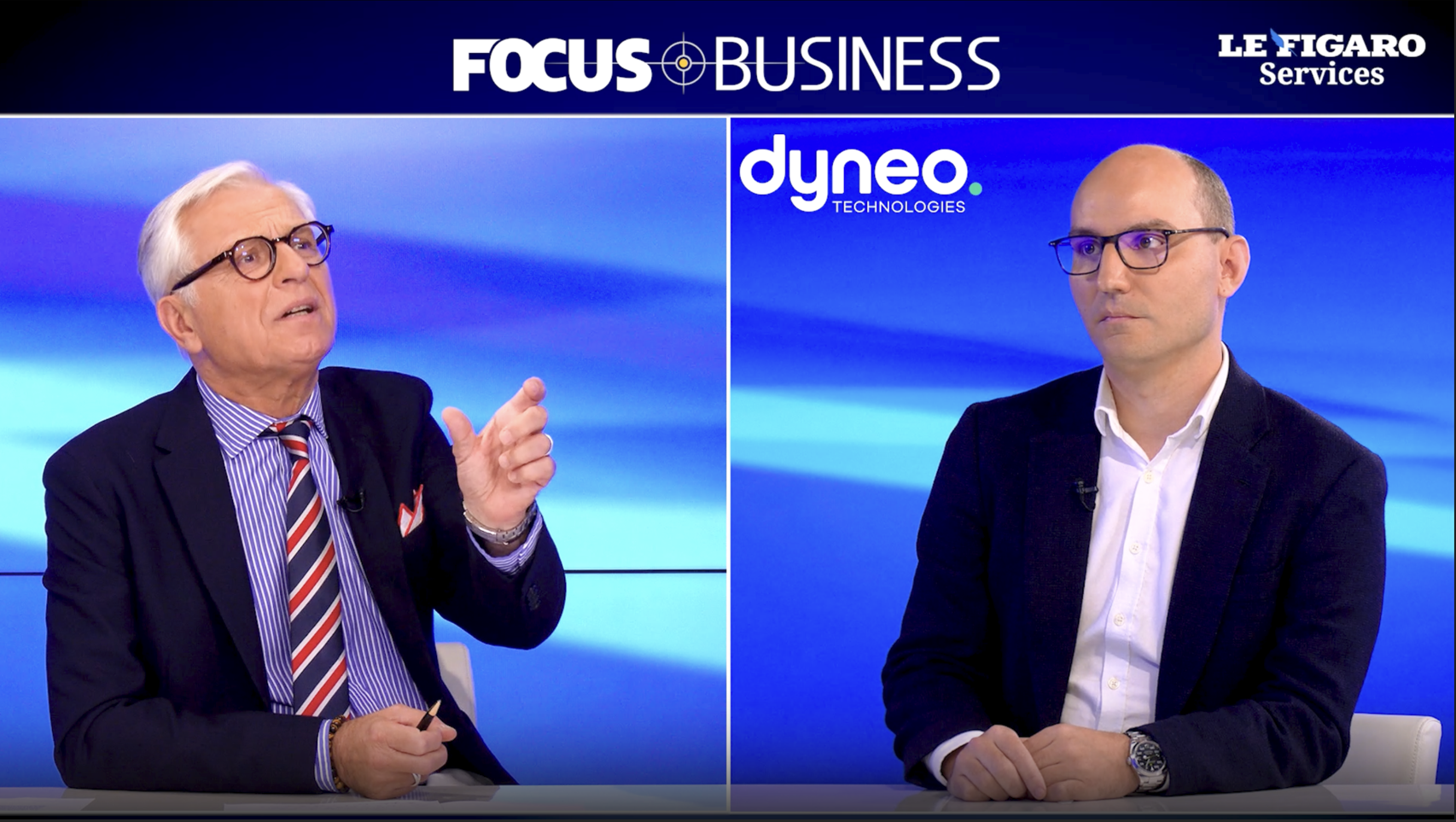
Read the interview with Maël Perret, co-founder and CEO of Dyneo, published in Le Figaro.
Our goal is to make heating networks smarter. We collect data from the facilities, verify its quality, and then use it to improve operations.
This is what makes it possible to reduce heat loss, improve production efficiency, and identify buildings where performance is declining. Every energy savings also translates into financial savings. The operator benefits from a more profitable facility, and the customer receives local, carbon-free, and affordable heat at a price that is as stable as possible compared to fossil fuels.
A dashboard isn't enough. What matters is that data leads to action. We need tools capable of continuously diagnosing issues, monitoring performance, and managing facilities. That's what enables us to support local governments and operators throughout the entire value chain.
We have two types of customers. There are local governments that operate their own networks, and companies that operate public networks under public service concessions.
In France, we are working with Veolia on two district heating networks near Grenoble under a 15-year contract. Digitalization is playing an increasingly important role in this type of project. Local governments are demanding high-performance infrastructure, precise monitoring, and greater transparency for subscribers—that is, the owners and managers of connected buildings. We are implementing tools for continuous monitoring and performance diagnostics, and the data also simplifies billing and customer relations.
A municipality that operates multiple networks must also make the most of its budget and technical staff. In many infrastructure systems, a failure is still often discovered only on the day the customer runs out of heat or hot water. We want the operator to identify the failure or anomaly before users are affected by it.
Decarbonization first. In France, utility networks must increase the shareof renewable and recovered energy in their mix, particularly through biomass and waste-to-energy. This share of renewable and recovered energy also affects the network’s finances, as it determines the applicable VAT rate.
Next, the price. A grid must be efficient enough that homeowners choose to connect to it rather than install an individual solution. That’s where the balance lies: decarbonizing while ensuring that energy is competitive and as stable as possible.
Finally, decisions are made with a long-term perspective. Our shortest contracts last three years, while others span several decades. We must therefore demonstrate the long-term value of our technology to both local governments and large operators.
This is a real challenge. There are eight of us, dealing with large-scale, mission-critical infrastructure, and we need to convince others that a team like ours can support companies like Veolia.
Our strength lies in the complementary nature of our professional backgrounds. I am a building energy engineer specializing in the optimization of heating and cooling systems, with fifteen years of experience at major engineering firms in Switzerland and abroad. Max Carrel is a physicist from EPFL who specializes in data processing. By combining these two areas of expertise, we have developed a technology that collects, monitors, analyzes, and controls building systems.
The Technology Fund is supporting us as we continue this development. This support confirms the soundness of our approach and helps us prepare for large-scale deployment.
To have the greatest possible impact. Many innovations work well on a small scale but become complicated when it comes time to roll them out more widely. That’s why we planned for a European-wide rollout from the very beginning.
We started in Switzerland, then launched our first client projects in France. We also have contacts in the United Kingdom, Poland, and the Netherlands.
The energy transition will not come solely from new sources of energy generation. We will also need to make better use of existing infrastructure, understand how it works, and make its performance measurable. It is on this ability to turn data into action that we are building Dyneo.


