Our client needs to lower the temperature of its district heating network to integrate new renewable energy sources (heat pumps, waste heat, solar thermal). In just four weeks, Dyneo connected dozens of substations and provided the necessary analyses to manage this temperature reduction without replacing the heat exchangers, resulting in significant cost savings.
To integrate more low-temperature renewable energy, CADouest needed to lower the temperature level of its network. However, several obstacles made this transition challenging:
- Lack of digitalization: The network operated without a tool to accurately track performance on a substation-by-substation basis.
- Lack of visibility regarding heat exchangers: it was impossible to determine which heat exchangers could handle a reduction in capacity without compromising service.
- Budgetary and time constraints: Replacing the underperforming heat exchangers would have required a significant, multi-year investment.
The challenge, therefore, was to precisely identify the critical substations in order to target maintenance efforts and maintain service quality for customers.
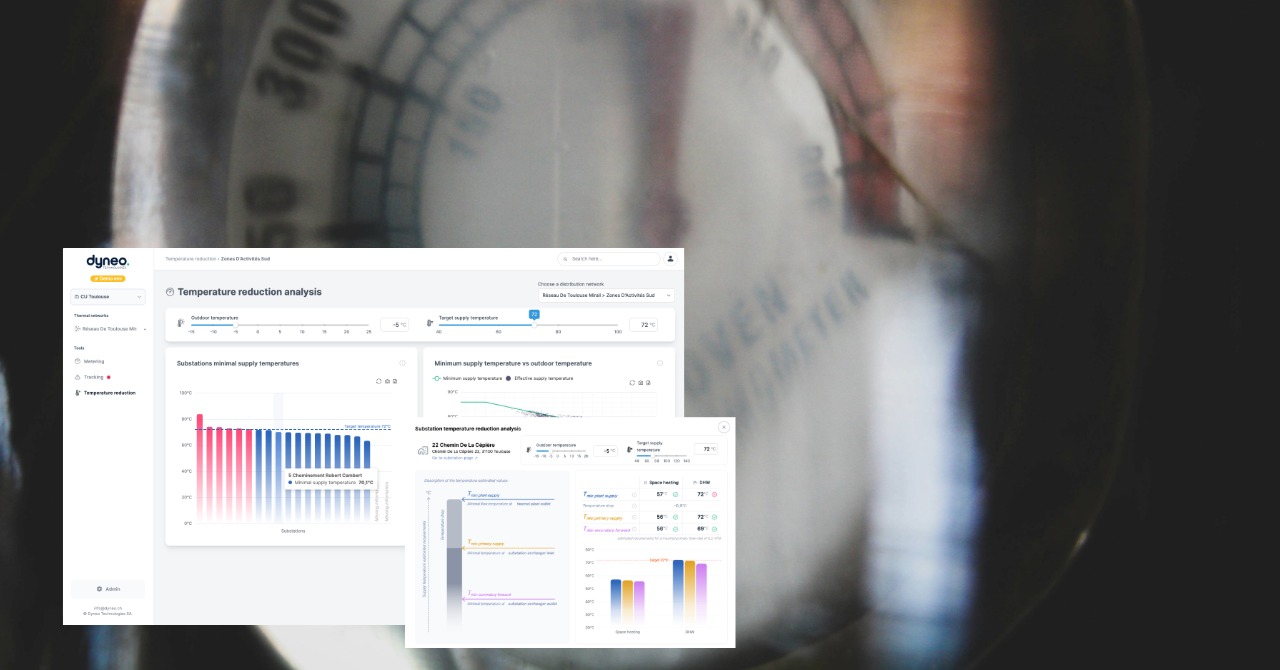
Dyneo implemented an IoT retrofit solution at dozens of substations over a four-week period, without any service interruptions:
1. Substation connectivity: installation of M2M gateways that continuously collect data on temperature, flow rates, and power demand.
2. Heat exchanger modeling: Dyneo’s algorithms characterized the thermal performance of each heat exchanger (NTU, efficiency) to simulate their behavior at lower temperatures.
3. Risk mapping: identifying substations that can accommodate the voltage reduction without replacement and those requiring targeted action.
4. Progressive control: dynamic adjustments to setpoints accompanied by real-time monitoring of the impact on subscriber service.
Deployment over four weeks across dozens of substations, without major work on the existing infrastructure.
Accurate identification of heat exchangers to be optimized in order to achieve reduction targets without systematically replacing them, resulting in a significant reduction in projected capital costs.
Improved energy efficiency through continuous optimization of control settings.
Reduced maintenance costs by minimizing equipment wear and tear and avoiding premature replacements.
Our client now has a continuously updated operational database that will guide every step of its transition to a low-temperature network—a prerequisite for maximizing the share of renewable energy in the generation mix.


